
“I wrote the one book I thought this world needed.”
— Trenton Tompkins
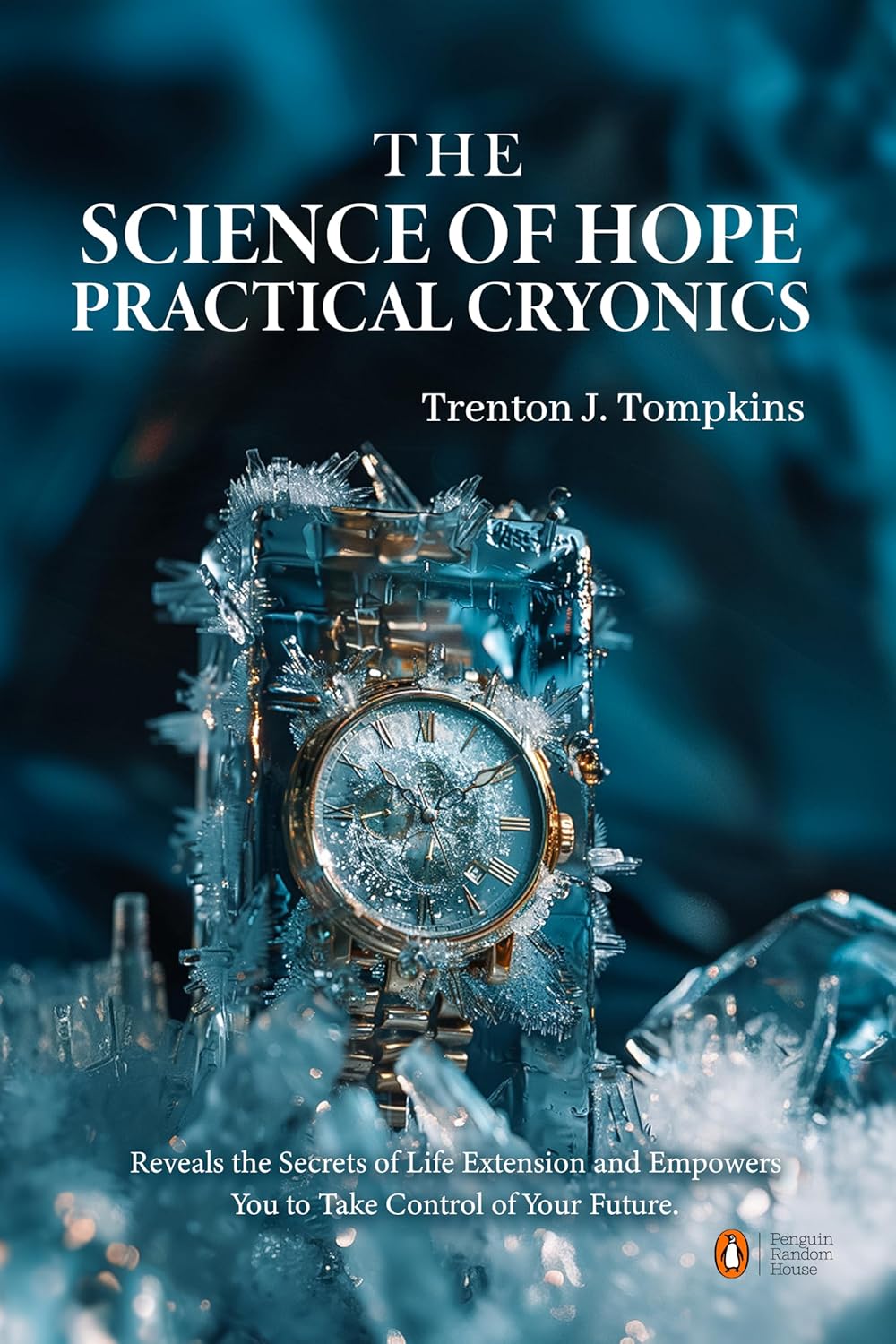
A practical, serious introduction to cryonics—covering the science, ethics, logistics, and decision-making framework for readers who want to examine the subject rationally.
Written by Trent Tompkins for readers willing to take the question of death, technology, and long-term survival seriously.
Contact / Get Updates
Have a question about the book or want updates? Fill this out and I’ll follow up.
About

But human history is, in large part, the story of boundaries dissolving.
Cryonics proposes that another boundary may be similarly provisional.
Practical Cryonics examines this claim from three angles.
First, the science: what modern vitrification can and cannot preserve, and what it means to speak of the brain as an information-bearing structure.
Second, the ethics: whether extending the possibility of life is an act of hubris, desperation, or moral responsibility.
Third, the logistics: how individuals can think rationally about cost, risk, probability, and long-term outcomes without resorting to fantasy or denial.
History suggests otherwise.
From anesthesia to antibiotics to organ transplantation, interventions once considered impossible have become ordinary. Each advance required a willingness to revise what counted as inevitable.
Practical Cryonics does not promise immortality. It does not claim that future revival is guaranteed. It asks a narrower question: if death is a process rather than an event, and if that process can be interrupted, what follows from that possibility?
At minimum, it requires us to reconsider what we mean by realism. There is a difference between acknowledging uncertainty and prematurely closing the door on future competence.
Life is finite under current constraints. Whether those constraints are permanent is an open question.
This book is for readers willing to examine that question seriously.
Sample Chapter: I. First Principles
For thousands of years, death was final. Then, in 1957, the first external defibrillation occurred. Electricity gave scientists the ability to restart the hearts of patients who, a decade before, would have been pronounced dead. Of course, this technology didn’t become available everywhere overnight. Many people that could have been saved by this new technology still died, as the medical establishment caught up to the new reality enabled by defibrillation.
We tend to think of reality as an objective truth. “Be realistic” is the admonishment given to school children and visionaries alike. But reality changes all the time, especially in terms of what is possible. Cars don’t drive themselves, or at least not, until they do.
Humans are great at telling themselves they understand reality. Disease? Simple, it’s caused by an imbalance of the four humors, phlegm, blood, black-bile and yellow-bile. Or the will of God. Or bad air, or witchcraft, or the devil. If there is one constant through history, it is how rarely people don’t have an explanation for something, even if that explanation is completely wrong.
Why does this matter in a book about cryonics?
Because cryonics is a bet. That doesn’t mean a gamble. But there are two parts to cryonics. The first part is the actual science of freezing a human body and preserving it in a way that provides for the best chance of future revival. That part can be done with the science we have today, and in that regard, cryonic preservation is a legitimate medical procedure, albeit an experimental one.
But cryonics is also a bet that future technology will make revival possible. People make bets like this all the time, when they buy stock in NVIDIA expecting next year’s graphics card will be better than this year’s or when they invest in a biotech startup hoping that their new cancer drug will pass clinical trials. Making these bets requires predicting the future accurately, and predicting the future accurately requires accurately understanding the present. Or luck. Or someone who can guide you through the decision-making process, which I hope to now do.
When I was a kid, I never thought a website like YouTube would be possible. Video files were big. Sharing video files took a lot of bandwidth, and that bandwidth was expensive. The first hard drive I ever bought cost $300 and held 10 gigabytes of data. I thought anyone who tried to let other people upload all the videos they wanted for free would go broke on storage and bandwidth costs. I was, thankfully, wrong. Google bought YouTube for $1.65 billion in 2006, probably not 5 years after I was sure the idea would be “impossible”.
What I find most interesting about this isn’t just that I was wrong, but how sure I was despite having actually very little information. I knew what hard drives retailed for, I knew what a few web hosts charged for bandwidth, but I had no idea what the people selling the bandwidth as part of their retail hosting packages paid for it. I had no idea what advertisers were willing to spend for targeted traffic. And while I knew that the price of storage went down every year, I’m not even sure I factored that into my calculations. I made a bad prediction for the future, because my model of reality was bad.
Author and psychiatrist Jordan Peterson calls these sometimes false and incomplete beliefs that shape our view of reality “fundamental presuppositions”. He emphasizes that these underlying beliefs or assumptions shape our worldview and behavior, often without conscious awareness. When people speak critically of why cryonics won’t work, one popular reason that people will give is “ice crystal formation damaging cells”. Yet modern cryonic procedures produce virtually no ice crystals. It is true that this was an early problem with the idea, but tens if not hundreds of thousands of hours have gone into researching the methods used in cryonics today, which produce virtually no ice crystals.
But most people have been taught since birth that death is unavoidable and that “Life is short”. Changing that fundamental assumption means adopting an entirely new model of reality. And there is a problem that occurs if one accepts the fact that death is avoidable. If death can be avoided, then it seems logical one should try to avoid it. That means signing up for cryonics, and paying for it, and maybe even realizing that the loved ones that you have buried could have lived — that they were the people who could have been defibrillated but were instead pronounced dead on the table.
That is a painful realization to accept, especially when one considers how many deaths could have been avoided with cryonics. But again, this is not a unique situation. Perhaps hundreds of thousands of people in the past died simply because doctors and surgeons didn’t wash their hands. It was not uncommon for a doctor in the 1800s to go from autopsying a diseased corpse to delivering a baby, often killing the mother in the process. But even when a Hungarian physician, Ignaz Semmelweis, discovered the problem and implemented a solution that was shown to work, doing things differently meant accepting that they had done them wrong in the past. One doctor, upon realizing he had unknowingly caused the deaths of so many patients, including his niece, felt so much guilt that he committed suicide. But it wasn’t just denial. The hygienic procedures were more time-consuming and expensive for the hospital than doing nothing. It was easier for those in charge to pretend as if the data showing the effectiveness of the new procedures was flawed or simply did not exist.
Belief perseverance describes how we continue to hold onto established beliefs even when faced with clear, contradictory evidence. We tend to prioritize our initial conclusions and resist changing our minds. It is easier to just concoct a reason that cryonics can’t work. And so, people readily believe that ice crystals form in cryonics patients and cause damage that can never be reversed.
Except, this doesn’t happen. Modern cryonics patients are not frozen so much as they undergo a process of vitrification, where the fluids in their body achieve a glass-like state without the formation of ice crystals. This can be confirmed by looking at other vitrified specimens of brain tissue under a microscope. Any ice crystals, especially those large enough to damage cells, would be easily visible, and they simply do not occur with modern cryonics methods.
But the people looking for a reason for cryonics not to work aren’t particularly concerned about advancements in science. The idea that humans, no matter how advanced, would be forever thwarted by the one-time formation of ice crystals that may puncture the linings of some cells seems to both overstate a minor problem and understate the much larger one of actually bringing a frozen human being back to life, but it also assumes that cells will need to be fixed. This assumption is based on a model of reality, which I believe may be deeply flawed.
In his book, which was published in 1964, The Prospect of Immortality, Robert Ettinger, the “father of cryonics”, makes some predictions about the future state of cryonics and how revival may be possible. Many of these predictions have aged badly. For example, he references a prediction made by Lee B. Lusted, a chemical engineer, that artificial organs with “electronic-control systems” would be able to replace nearly all of our organs by 2014. Other predictions have fared better, for example, organ transplants and transplants from animals, known as “xenotransplantation”.
While Ettinger’s predictions offered a glimpse into the possible future of cryonics, it’s clear that technological advancements often take unexpected paths. Some of his predictions, like the development of artificial organs with “built-in electronic control systems”, may have been overly optimistic, yet others, like organ transplants and xenotransplantation, have made significant strides. This divergence between prediction and reality highlights the unpredictable nature of technological progress.
Building on this idea, I believe that the path to reviving cryonically preserved individuals may not require the methods Ettinger envisioned. Instead, the future of cryonics might lie in leveraging cloning technology — a field that has already shown remarkable promise. Rather than focusing on repairing the damage at the cellular level within the original body, we may find that creating a new, genetically identical body provides a more efficient and feasible solution.
I believe that cryonics will be able to bring people back without ever needing to restore functionality to their cells. That is not to say that the latter task would be impossible, simply that I think it would be needlessly complex and unnecessary. I also believe that the technology to repair an entire body, cell by cell, molecule by molecule, will only be perfected long after the technology to bring someone back in a new body has been discovered, and by that point, everyone who could be revived will likely already have been.
To understand how this might be possible, let’s start with what science already knows how to do.
Science already knows how to completely replace your entire body, every cell of it, with a new, cloned version. This isn’t even cutting-edge science. Dolly, the first cloned animal, was created in 1996. The reasons that a human being has not yet been cloned (if indeed one has not) are legal and ethical, not technical in nature. If ethics and laws were removed from the equation, a person with the resources could, with current technology, create a clone of themselves to provide a complete source of younger, fully compatible transplant organs, and swap out their failing or cancerous organs with relative ease.
The ease in which a new, genetically identical body can be created offers the possibility of effectively “solving” medicine. In the future, minor ailments may still be treated with currently used drugs, but major health problems, including aging, will likely be addressed by simply replacing a patient’s entire body. It is this step, and not the reanimation of a frozen corpse, that I see as being the fundamental problem of revival.
II. Understanding Free Will
In classical mechanics, the physics of Isaac Newton, and even in special relativity, there is a concept known as determinism. Determinism is the belief that the current state of a “system”, whether it is an apple falling from a tree or a planet rotating around a star, is caused by its previous state, and if one knew all of the properties of all the items in that system, they could predict with complete accuracy the progression of that state. This model works for large, inanimate systems…
Practical Cryonics
About the Author — Trent Tompkins

I wrote Practical Cryonics for one simple reason: I have a daughter.
Eventually, it became obvious that the book I was looking for did not exist.
So I wrote it.
Practical Cryonics is my first published book. It represents years of reading, questioning assumptions, and trying to think honestly about mortality, probability, and responsibility. I do not write as a medical authority or academic insider, but as someone willing to examine uncomfortable ideas seriously and follow them to their logical conclusions.
At its core, Practical Cryonics reflects a simple conviction:
If death is a process rather than an instantaneous event, and if future technology may one day reverse what medicine cannot today, then choosing preservation is not an act of hope guided by reason.
When I imagine the best possible future, it is not wealth or status that comes to mind.
It is time.
Time with the people I love. And health, and their health, and youth.
Forever, in a future world that gets progressively better every day. Richer, smarter, more just, more exciting.
And if there is even a small chance to have more of it, that possibility is worth taking seriously.
Photos